I put exactly 43,231 people into one access log and asked five open source access log analyzers to count them: GoAccess, AWStats, Webalizer, Matomo’s log importer and lnav. The lowest answer was 49,616. The highest was 105,885.
My bet going in was that bots would explain any disagreement: each analyzer ships its own crawler list, and I expected the visitor counts to line up once the crawlers were gone. A visitor is a person, after all.
So I took every bot out and ran the tools again.
The counts still ran from 49,576 to 60,209. Not one landed near 43,231.
That’s when I stopped reading “unique visitors” as a headcount. A log analyzer doesn’t count people. It counts whatever its own rule calls a visitor, which makes “unique visitors” from a log a setting, not a measurement. Visits and pageviews are the numbers you can actually compare, and on that bot-free log they stayed within 1.4% of the truth.
Lab: 2 vCPU · AlmaLinux 10.2 · 4 Nov 2026
The chart below lines up what each tool said about the full log against the real number of people. GoAccess is in it twice, with and without one flag, and lnav isn’t, because it has no notion of a visitor.
Look for a bar that stops short of the mark. There isn’t one.
Every bar overshoots, and the two longest are the same program, GoAccess, which a single flag takes from 105,885 to 67,863.
That looked like proof of the bot theory. It was only part of the story.
How Do I Know It’s 43,231?
Because I wrote the log myself.
A real access log would have been useless for this. It’s personal data, for a start, and nobody can tell you how many people are really in one.
So every line in mine is fake, and for each one I know whether a person or a bot made it.
A small Python script writes a month of nginx log in the default combined format, 1 to 31 October 2026, loaded with the situations where analyzers usually disagree.
Phones pick up a new address on most visits. An office of 75 people sits behind three addresses. Of the 43,231 readers, 3,586 come back, a few almost every day, and some switch between a laptop and a phone.
Then come the bots. Search crawlers, AI crawlers, an uptime monitor and Mastodon’s link previews all sign their own names. Two visitors lie: a scanner posing as Chrome 91 that only probes paths like /wp-login.php and /.env, and a scraper posing as Chrome 141 that asks for real pages.
None of it ran cleanly the first time. My first log started on 5 October and crossed into the next month, which was a mistake, because AWStats, Webalizer and Matomo all report by calendar month and visitors from two partial months don’t add up. I regenerated it to cover exactly one. Then AWStats 8.0 refused to start without two Perl modules, and the Webalizer binary wanted a Berkeley DB library my AlmaLinux box didn’t have. Both fixes are in the lab notes at the end, with the exact error lines.
Every tool ran on its defaults, with a second pass wherever a default looked like a trap (I’ll flag those as I go).
Here’s the finished log as the generator describes it, and the part to watch is the split between people and bots.
The three figures to hold on to are the answer key: 43,231 people, 60,706 visits and 109,351 pageviews. Everything a tool prints from here on gets marked against them.
Maybe It’s Just the Bots?
That was the bet, and the first run seemed to back it. Bots and scanners wrote 118,216 of the 502,103 lines, almost one in four, and how many leak into a report comes down to the list each tool ships with.
GoAccess is the odd one. It recognizes nearly all the crawlers in the log and labels them in the Browsers panel, then counts them as visitors anyway. Only --ignore-crawlers takes them out, and that one flag is the whole distance between 105,885 and 67,863.
Webalizer has the opposite problem, because the maintained fork, Stone Steps Webalizer, ships with no robot list at all. As shipped it reported 166,295 visits for a log that holds 60,706, and 9,855 of them went to the Chrome 91 scanner, which never got a single successful response.
Ten Robot lines of my own cut the total to 76,901.
The other two needed no help. AWStats had the most complete list. It knows GPTBot by name and catches ClaudeBot, PerplexityBot and the Mastodon fetcher with generic patterns. Matomo’s importer matches substrings such as bot/ and robot, which missed only Mastodon’s agent (it ends in a bare “Bot”), and Matomo itself dropped Mastodon’s requests while recording them.
So far the theory held: different lists, different leaks.
The grid below sets six kinds of traffic against the four tools that count visitors. Read it from the top, and watch the bottom row.
Nobody caught the scraper.
Its 7,285 page requests sit in every report, 6.7% on top of the real pageviews, and no user agent list will ever fix that, because the agent it sends is an ordinary Chrome 141.
Only behavior gives it away: 40 addresses in one range, no CSS or JavaScript requests, never a referrer. None of the five tools looks at behavior (my guide to bot traffic detection covers what to check by hand).
The first crack in the bet came from AWStats. It had removed every bot that gave its name, and the scraper it missed hides behind 40 addresses. The visitor count it reported was still 14.8% too high.
Would the tools agree if the log had no bots in it at all?
No Bots Left, and the Counts Still Don’t Agree
I cut the log down to the 383,887 lines that people made and reran the four tools that report visitors. AWStats said 49,576 and Webalizer 49,945. GoAccess said 59,578 and Matomo 60,209.
The right answer was still 43,231.
This was the result I hadn’t bet on. The spread had narrowed, and it was no longer about bots. Each tool carries a rule for what a visitor is, and these four use three different ones.
The diagram below runs two readers through all three: one who opens the site on a laptop on five days, and one on a phone that arrives from five addresses. Count the visitors each rule makes of them.
AWStats and Webalizer count addresses per month. The laptop gets off lightly and the phone turns into five people. The same rule folds the 75 office workers into three, a weakness the AWStats glossary states plainly. On this log the phones outweigh the office, and the count lands about 15% high.
GoAccess counts each combination of address, date and user agent, and says so under the panel title: “Hits having the same IP, date and agent are a unique visit.” A loyal reader becomes a new visitor every day they show up. Over a month that’s closer to daily visitors added up than to people. The log holds 59,217 person-days, and GoAccess reported 59,578. I haven’t traced the remainder line by line. My guess is readers who changed address or device inside one day.
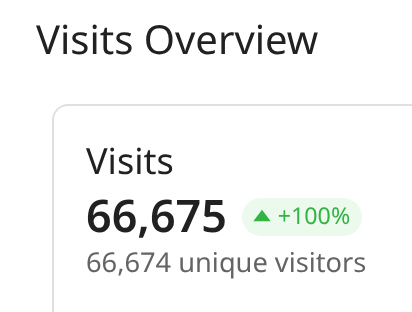
Matomo’s rule surprised me most. The log carries no cookie, and without one Matomo recognizes a reader only inside an open visit. The next visit gets a fresh random visitor ID (you can see it in core/Tracker/Visit.php), and every visit becomes a new person.
You don’t have to take my word for that. Here is Matomo’s own overview after the full-log import, cropped to the two figures that matter.
 One apart
The two figures are one apart.
In a month when 3,586 readers came back, Matomo’s Returning visitors report found exactly one.
Is any of this a bug? I don’t think so. Each tool does what its own documentation or source code says it does, and they say three different things under one label.
So Which Numbers Can You Trust?
Visits and pageviews, the two I’d have called fuzzier. A visit hangs on a timeout somebody picked. A pageview is whatever the tool decides counts as a page.
On the people-only log, every tool that reports visits landed within 1% of the real 60,706. Webalizer missed by 43, because office workers who share an address and overlap in time merge into one visit. AWStats and Matomo came in about 500 lower for a shared reason: both open a visit only on a successful page view, and a reader who landed on the moved post, got a 404 and left never becomes a visit at all.
Pageviews were tighter still, with AWStats and Matomo both printing 109,351, the true number to the last request. Webalizer printed 110,904, which is the true number plus the 1,553 page requests that ended in a 404 or a 500.
Why is a visit easier to count than a person?
Because a visit only asks the tool to follow one address for an hour at most. A person asks it to follow someone for a month, across networks and devices, and nothing in a log line can do that.
Here are all three metrics on one scale, as the distance between each tool and the truth on the bot-free log. Two groups sit on the zero line, and one is nowhere near it.
WebalizerGoAccess,
Matomo
The full log, bots included, gave me one more reason to trust pageviews. AWStats, Matomo and lnav’s count of browser-like agents all came to 116,636. That’s the real 109,351 plus the scraper’s 7,285, and not a request more.
When three unrelated programs agree to the last request, I believe the number. When visitor counts miss by 15% to 39% on a cleaner log, I believe the label means something different in each tool.
Which Access Log Analyzer to Pick, and How Long You’ll Wait
If the visitor count can’t pick a winner, what can? Mostly the job you have in mind.
All five are open source log analyzers with a release in the last 15 months. All five read the combined format too, so the shortlist is the same whether you need an nginx log analyzer or an Apache log analyzer.
If you came looking for GoAccess alternatives, or for an AWStats alternative now that the 8.0 changelog calls it the last version its original author will maintain, here’s how I’d split the work:
- GoAccess for a fast report or a live dashboard from one binary. Pass
--ignore-crawlers, or about a third of your “visitors” will be bots. - AWStats for a monthly archive that builds itself from cron. It had the best bot list of the five out of the box.
- Webalizer (the Stone Steps fork) for the fastest static report, as long as you write the robot list it ships without.
- Matomo’s log importer if you already run Matomo or want goals, segments and a full interface over old logs. Without cookies, every visit is a new visitor.
- lnav for questions nobody built a report for, asked in SQL. It has no idea what a visitor is, which made it the best referee in this test.
Speed is the one measure that splits them cleanly. Each command ran three times on the same two pinned cores. One bar in the chart of medians dwarfs the other four.
Matomo’s four minutes of import plus 25 seconds of archiving are fine for a month of log this size, and they buy you a database to segment later. That’s still about 43 times longer than GoAccess.
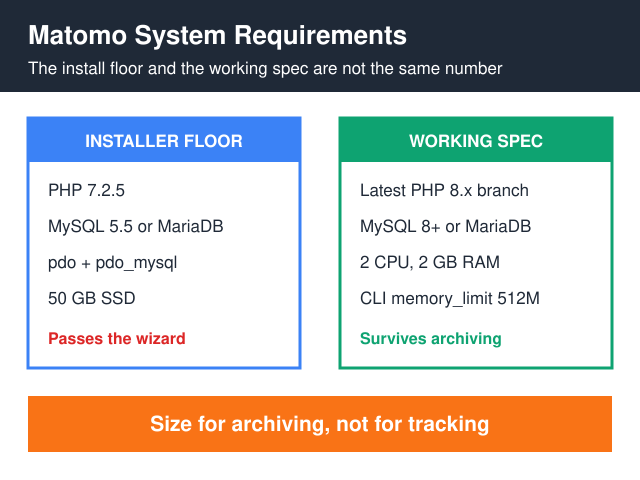
It’s also the only one of the five that needs a database and a web server first (my Matomo setup guide and system requirements page cover that part). The other four finish in under 20 seconds, fast enough to change a flag and run again.
What This Test Doesn’t Prove
The log is synthetic, and that cuts both ways.
It’s the only reason I can write “43,231” and mean it. It’s also why the 23.5% bot share and the mix of phones, offices and loyal readers are my choices. They measure nothing about the internet.
Can you carry these percentages over to your own site? No. Here the phones outweigh the office, and counting addresses lands 15% high. On a site read mostly from a few company networks I’d expect the same rule to land low, though I haven’t tested that.
The mechanics do carry over: which rule a tool applies, and what that rule does to the same lines.
Find Out Which Rule Your Own Report Uses
You can’t know how many people are in your own log, but you can find out what your report is counting. Is its “unique visitors” figure closer to distinct addresses, or to distinct pairs of address and user agent? One lnav query counts both:
lnav -n -c ";SELECT count(*), count(DISTINCT c_ip), count(DISTINCT c_ip || ' ' || cs_user_agent) FROM access_log" access.logThree numbers come back: lines, distinct addresses, and distinct pairs of address and agent. If your monthly visitors sit near the second one, your tool counts addresses, as AWStats and Webalizer did here. On the full log, lnav’s distinct addresses and Webalizer’s hosts were the same 50,707.
Two GoAccess flags are worth a minute too (my GoAccess guide has the full setup). Run the report with and without --ignore-crawlers and see how far the visitor count moves, then add --unknowns-as-crawlers if uptime monitors hit your site, because the first flag leaves them in.
And if you run Webalizer, check whether its config has any Robot lines at all.
What You End Up With
I started out asking which access log analyzer counts visitors correctly. I’m finishing convinced the question has no answer. There are no people in an access log. There are addresses, dates, user agents and lines, and every “visitor” in every report is one program’s way of grouping them.
Two disagreeing reports are less alarming once you see it that way. Neither is broken. They’re answering different questions under the same label, and once you know which rule sits behind the label, you can say what the number means.
For anything I need to compare, between two tools or two months, I now use visits and pageviews and leave unique visitors out of the sentence. (A scraper with a browser’s user agent is still in those numbers.)
If you need to know who actually came back, a plain access log won’t tell you. For that you need something running on the page, and my self-hosted analytics guide compares the tools you can run next to your logs.
The log never had a headcount in it. I only read one into it.
Lab notes: commands, versions and full tables for all five log analyzers# 2 vCPU · AlmaLinux 10.2
These are my lab notes for each access log analyzer tool in the test, exactly as I ran it on 4 November 2026. If you’re choosing access log analyzer software for your own server, the commands below are the ones that worked, and the errors are the ones I hit.
The lab and the log
The server has 2 vCPU and runs AlmaLinux 10.2. Every timed command was pinned to the same two cores with taskset. Nothing was installed system-wide, and the Matomo services were stopped after the test.
The log is one file in the nginx combined format for a blog on example.com, covering 1 to 31 October 2026. Every address comes from private or documentation ranges: 10.0.0.0/8, 192.0.2.0/24, 198.51.100.0/24, 203.0.113.0/24 and 2001:db8::/32.
- 502,103 lines in total: 383,887 from people and 118,216 from bots and scanners (23.5%).
- 43,231 people, 3,586 of them returning, in 60,706 visits.
- 109,351 pageviews with a 200 response, out of 110,904 page requests by people. The other 1,553 ended in a 404 or a 500.
- 59,217 person-days, which is what you get when you add up each day’s unique people.
- Bot lines by kind: search crawlers 46,305, AI crawlers 38,535, uptime monitor 9,041, link previews 1,874, scanner posing as Chrome 91 15,176, scraper posing as Chrome 141 7,285.
Versions and licenses
| Tool | Version tested | License |
|---|---|---|
| GoAccess One C binary |
1.12, 16 Sep 2026 | MIT |
| AWStats Perl script and data files |
8.0, 26 Aug 2025 | GPL v3 |
| Webalizer (Stone Steps) One C++ binary |
6.4.0, 23 Aug 2026 | GPL v2 |
| Matomo log analytics PHP app, MySQL, Python importer |
Matomo 5.14.2, 22 Oct 2026, with MySQL 8.4 | GPL v3 |
| lnav One static binary |
0.14.1, 5 Sep 2026 | BSD 2-Clause |
GoAccess 1.12
Built from source, which only needs the ncurses headers. Ubuntu 24.04 ships 1.8.1 and Debian 13 ships 1.9.3, so build it or use the project’s own repository if you want 1.12. One command produces the HTML report:
goaccess access.log --log-format=COMBINED -j 2 -o report.html
I ran it three times: on defaults, with --ignore-crawlers, and with --unknowns-as-crawlers added on top. For daily runs, --persist and --restore keep its history between reports.
AWStats 8.0
AWStats is a Perl script that reads the log and keeps a data file per month. These are the lines in a copy of awstats.model.conf that matter for an nginx combined log. LogFormat=1 is already the default, and DirData has to point at a writable folder:
LogFile="/var/log/nginx/access.log"
LogFormat=1
SiteDomain="example.com"
DNSLookup=0
One command updates the data and a second one writes a static page:
perl awstats.pl -config=example -update
perl awstats.pl -config=example -output -staticlinks -month=10 -year=2026 > awstats.example.html
Version 8.0 loads the JSON::XS and Try::Tiny Perl modules at startup, so the bare tarball refuses to run on a minimal box. Debian 13 packages 7.9, and 8.0 has reached Debian testing. The 8.0 changelog says it will be the last version maintained by the original author, Laurent Destailleur.
AWStats remembers the last line it read and skips everything before it on the next run. That’s what you want from cron, and it’s a trap in testing: a second test on the same data folder reports nothing new.
Webalizer 6.4.0, the Stone Steps fork
The original Webalizer stopped at version 2.23-08. Ubuntu 24.04 still packages it, and Debian 13 no longer does. The maintained line is Stone Steps Webalizer, which released 6.4.0 in August 2026 with ready binaries for Debian, Ubuntu, Fedora and Windows. I used the Fedora build:
webalizer -c webalizer.conf access.log
The shipped sample config contains no robot patterns, and the manual confirms that the default for Robot is none. I ran it twice: once as shipped, and once with these ten lines appended:
Robot  Googlebot/        Googlebot
Robot  bingbot/          Bingbot
Robot  Applebot/         Applebot
Robot  GPTBot/           GPTBot
Robot  ClaudeBot/        ClaudeBot
Robot  PerplexityBot/    PerplexityBot
Robot  CCBot/*           Common Crawl
Robot  UptimeRobot/      UptimeRobot
Robot  Mastodon/*        Mastodon
Robot  python-requests/* python-requests
With robot patterns in place, Webalizer reports human and robot totals separately (the robot side came to 87,316 pages and 89,315 visits). Without them, every line lands in the top block.
Matomo 5.14.2 and its log importer
Matomo ships a Python script, misc/log-analytics/import_logs.py, that replays log lines as tracking requests. It needs a running Matomo, so the lab got a private MySQL 8.4 instance on a Unix socket and PHP’s built-in web server on 127.0.0.1.
python3 misc/log-analytics/import_logs.py --url=https://matomo.example.com/ \
  --idsite=1 --recorders=2 --auth-config=auth.ini access.log
./console core:archive --force-all-websites --url=https://matomo.example.com/
The auth.ini file holds the login in an [auth] section. The script now marks --token-auth on the command line as deprecated and insecure.
By default the importer tries to mimic the JavaScript tracker, so it skips bots, static files, HTTP errors and redirects. The Matomo log analytics page mentions the alternative: track bots and tag them with a custom variable, which is the --enable-bots switch.
On the full log, 118,225 requests went in and 116,636 pageviews came out. The difference is the 1,589 Mastodon preview requests that passed the importer and were dropped by Matomo while recording. With two recorders the import ran at about 490 requests per second.
lnav 0.14.1
A terminal log viewer with an SQLite engine inside. It recognizes the combined format on its own and exposes it as a table called access_log. Download one static binary and point it at the file (Debian 13 packages 0.12.4).
lnav -n -c ";SELECT count(*), count(DISTINCT c_ip), count(DISTINCT c_ip || ' ' || cs_user_agent) FROM access_log" access.log
One more query, a GROUP BY on the user agent, split the log into bot-like agents (100,172 hits, 83,043 successful page requests, 762 IPs) and browser-like agents (401,931 hits, 116,636 successful page requests, 50,199 IPs).
Full log, default settings
| Tool | Unique visitors | Visits | Pageviews |
|---|---|---|---|
| Real people in the log | 43,231 | 60,706 | 109,351 |
| AWStats 8.0 | 49,616 | 65,923 | 116,636 |
| Webalizer 6.4 As shipped, no robot list |
50,707 hosts | 166,295 | 211,531 |
| Webalizer 6.4 Ten Robot lines, human totals |
50,068 hosts | 76,901 | 124,215 |
| Matomo 5.14.2 Log import |
66,674 | 66,675 | 116,636 |
| GoAccess 1.12 With --ignore-crawlers |
67,863 | No such metric | No such metric |
| GoAccess 1.12 Defaults |
105,885 | No such metric | No such metric |
| lnav 0.14.1 SQL counts |
50,707 IPs | No such metric | 116,636 from browser-like agents |
The shared 116,636 is the real 109,351 pageviews plus the scraper’s 7,285.
People-only log, 383,887 lines
| Tool and visitor rule | Unique visitors | Visits | Pageviews |
|---|---|---|---|
| Real people Ground truth |
43,231 | 60,706 | 109,351 |
| AWStats 8.0 IP address per month |
49,576 14.7% over |
60,161 0.9% under |
109,351 exact |
| Webalizer 6.4 IP address per month, reported as hosts |
49,945 15.5% over |
60,663 0.07% under |
110,904 1.4% over |
| GoAccess 1.12 IP + date + user agent |
59,578 37.8% over |
No such metric | No such metric |
| Matomo 5.14.2 A new visitor for each visit |
60,209 39.3% over |
60,209 0.8% under |
109,351 exact |
AWStats and Matomo start a visit only on a successful page view. AWStats also groups by address alone and waits an hour of silence before it closes a visit, where Matomo and Webalizer wait 30 minutes.
How each tool handled the bots
Search crawlers
Googlebot, Bingbot, Applebot, CCBot
--ignore-crawlersAI crawlers
GPTBot, ClaudeBot, PerplexityBot
--ignore-crawlersUptime monitor
UptimeRobot
--unknowns-as-crawlersLink previews
Mastodon
Scanner posing as Chrome 91
Every request ends in a 404
Scraper posing as Chrome 141
Requests real pages
AWStats knows GPTBot by name and catches ClaudeBot, PerplexityBot and the Mastodon fetcher with generic patterns that look for “bot” next to a slash or a space. Matomo’s importer matches substrings such as bot/ and robot, which misses an agent that ends in a bare “Bot”.
Speed and memory
Median of three runs over the whole 502,103-line log, on the same two pinned cores.
| Tool and output | Time | Peak memory |
|---|---|---|
| Webalizer 6.4 Static HTML with PNG charts |
3.4 s | 107 MB |
| lnav 0.14.1, one query Terminal view or CSV |
4.5 s | 96 MB |
| GoAccess 1.12, 2 threads Terminal, HTML, JSON or CSV |
6.1 s | 59 MB |
| GoAccess 1.12, 1 thread Same outputs |
8.5 s | 47 MB |
| AWStats 8.0 Monthly data file, CGI or static HTML |
19.5 s | 51 MB |
| Matomo 5.14.2 Full web interface and API |
240 s import, then 25 s archiving | MySQL alone held about 660 MB |
The MySQL figure includes the 512 MB buffer pool I gave it, so read it as “a database server”, not as a tuned minimum.
Three things that broke
Can't locate JSON/XS.pm in @INC from AWStats 8.0. Install JSON::XS and Try::Tiny. On Debian and Ubuntu they are libjson-xs-perl and libtry-tiny-perl, which the Debian awstats 8.0 package now lists as dependencies. JSON::XS is only called for JSON log formats. My box had no Perl headers to build it, so for a combined log I put Try::Tiny and a pure-Perl stand-in into a private folder and pointed PERL5LIB at it.
libdb_cxx-5.3.so => not found in ldd webalizer. The Stone Steps binary needs the Berkeley DB C++ runtime. On Fedora that is the libdb-cxx package. On AlmaLinux 10 I found it only in the devel repository, so I unpacked the RPM into a folder and set LD_LIBRARY_PATH.
Matomo shows zeros after an import. Archiving hasn’t run. With browser-triggered archiving off, run core:archive. The importer prints the exact command when it finishes.